
A Note from the Author
Some have suggested that I focus too much on the Toronto Blessing and the Alpha Course. My response is simple: This was the first time I felt the weight of the command to "earnestly contend for the faith" (Jude 1:3-4).
I came to the Lord in 1994, at the very moment this "wild vine" was in its development stage. I have watched it act like a cancer within the Church—quietly moving through the body, replacing healthy, biblical cells with experiential delusion. Today, its tentacles reach far and wide into almost every denomination.
This isn't an obsession; it’s an observation of a spiritual contagion. If we do not understand "Patient Zero" (Toronto), we will never understand why the modern Church has become so spiritually malnourished
The Alpha-Toronto Nexus: A History of Experience and Its Critics
The Alpha course is often presented as a neutral tool for evangelism, yet its history is rooted in a specific, high-energy charismatic climate. While the course began in 1977 at Holy Trinity Brompton (HTB) in London, it remained a local program until the mid-1990s. At that time, it was "re-launched" by Nicky Gumbel, coinciding exactly with a spiritual phenomenon known as the "Toronto Blessing."
The Roots: HTB and the "Laughing Revival"
In 1994, leaders from HTB, including Sandy Millar and Nicky Gumbel, visited the Airport Vineyard Church in Toronto. They returned to London carrying what they described as a "new move of the Spirit." This movement was characterized by "manifestations"—uncontrollable laughter, falling in the "spirit," shaking, and even animal-like sounds.
Nicky Gumbel himself explicitly linked the success of Alpha to this movement. In 1995, he stated that it was "no coincidence" that the explosion of Alpha occurred at the same time as this outpouring, concluding that "the two go together." This association is most visible in the "Holy Spirit Weekend," the retreat that serves as the climax of the course. Critics argue that this weekend is designed to facilitate "Toronto-style" experiences, shifting the focus from the objective Word of God to subjective physical sensations.
A Historical Directory of Critics and Their Insights
As the course gained global momentum, many respected theologians and evangelists voiced concerns, focusing on what they termed a "feeble" presentation of the Gospel.
1. Cecil Andrews (Take Heed Ministries):
An "Anorexic" Christianity
Cecil Andrews provided one of the sharpest critiques of the course's ecumenical nature.
The Quote: He described the Alpha course as an "anorexic skeleton" of the Christian faith. His concern was that the course was so doctrinally "lite" that it allowed groups like the Roman Catholic Church to fill the gaps with their own dogmas, thereby compromising the "Sola Scriptura" (Scripture Alone) foundation of the Reformation.
2. Chris Hand: The Feeble Doctrine of Sin
In his critique Falling Short?, Baptist minister Chris Hand focused on the theological "thinness" of the Alpha curriculum.
The Quote: Hand noted that Alpha describes sin as "the mess we make of our lives" or "rubbish." He argued that this is a "man-centered" view. By failing to define sin as a personal rebellion against a Holy God, Hand claimed Alpha produces a "feeble atonement," where the Cross is seen as a solution to life’s problems rather than a rescue from God's righteous judgment.
3. The Berean Call (Dave Hunt): A Different Spirit
The ministry founded by Dave Hunt was a primary voice in the 1990s warning against the "occultic" nature of the
Toronto manifestations and the Alpha course.
The Quote: They argued that Alpha "does not present the God revealed in Scripture." Their concern was that the spirit" encountered during the residential weekend was an "invoked" spirit that bypassed the human mind, leading
participants into a state of passivity that they likened to New Age practices.
4. David Wilkerson: The Absence of Repentance
The founder of Times Square Church was famously vocal against the "laughing revival" that Alpha promoted.
The Quote: Wilkerson warned against "pillow prophets" who refused to preach the "fierceness of God's anger" against sin. He stated that any move of the spirit that resulted in "barking like dogs" or "rolling on the floor" was a "show and sham of man" and a distraction from the true work of the Holy Spirit, which is to convict the world of sin, righteousness, and judgment
James Jacob Prasch
1. The "Toronto Blessing" Connection
Prasch frequently highlights that the Alpha Course originated at Holy Trinity Brompton (HTB) in London, the church he identifies as the epicenter of the "Toronto Blessing" in the UK.
The Goal of Alpha: Prasch quotes Nikki Gumbel (the pioneer of Alpha) as stating that the "purpose of Alpha is the Holy Spirit weekend away," which Prasch argues is designed to draw people into the "Toronto experience" of manifestations like holy laughter and falling in the spirit [02:07].
Charismania: He labels these experiences as "charismania" and "chaos," arguing they discredit the true gifts of the Spirit and the Gospel in the eyes of unbelievers [04:45].
2. Failure to Disciple (Converts vs. Disciples)
A core theological objection Prasch raises is that Jesus commanded the making of disciples, not just converts.
Lack of Biblical Model: He asserts that Alpha contains "absolutely no biblical model of discipleship" [05:54].
Omission of Baptism: He points out that the first biblical step of discipleship—believer's baptism—
is notably absent from the course's framework [06:04].
3. Ecumenism and the "Different Gospel"
Prasch is a staunch critic of the course's compatibility with Roman Catholicism.
Compromise with Rome: He argues that because Alpha is "user-friendly" for the Roman Catholic Church, it must be compromising on essential Gospel truths [14:07].
Sacramentalism vs. Grace: He contends that the course fails to address the "bondage" of Catholic doctrines like purgatory and the mass, which he views as contrary to justification by faith alone [12:15].
The "Accursed" Gospel: Citing Galatians 1:8, Prasch warns that any program that validates a "different gospel" (such as sacramental regeneration) is under a biblical curse [10:21].
4. "Pneumocentric" vs. "Christocentric"
Prasch argues that the Alpha Course is dangerously focused on the Holy Spirit rather than Jesus Christ.
Wrong Focus: He describes the course as "Pneumocentric" (Spirit-centered) [17:40].
Biblical Standard: He emphasizes that the Holy Spirit's biblical role is always to point toward Jesus, not Himself [17:44].
He criticizes the practice of praying directly to the Spirit ("Come Holy Spirit"), stating it has no biblical precedent [18:27].
5. Seeker-Friendly "Cheap Grace"
Finally, Prasch critiques the tone of the course as being designed to avoid offense.
Avoiding Judgment: He calls it "cheap grace" that avoids "negative" biblical themes like death, judgment, and the necessity of repentance [19:27].
Pop Psychology: He argues that the course replaces sound doctrine with "programmatics and pop psychology" dressed up in Christian jargon [20:15].
Main Concerns and Theological Shifts
The collective argument of these men can be summarized into three main points of "false teaching" they perceived in Alpha:
The Subjective Turn: The "decisive moment" for a person on Alpha is often seen as the "experience" of the Spirit during the weekend, rather than a rational, heart-felt response to the preaching of the Cross.
The Therapeutic Gospel: Sin is presented as a "problem to be solved" to make life better (therapeutic), rather than a "debt to be paid" to a Holy Judge (judicial).
The Invocation of the Spirit: Critics note that Gumbel's videos often involve "invoking" the Spirit to "come now," a practice they argue is not found in the New Testament, where the Spirit is given to those who obey the Gospel.
In conclusion, these "upstanding men of God" did not critique Alpha out of a desire to be divisive, but out of a conviction that the "roots" of the course—the Toronto Blessing—had produced a "fruit" that was historically and biblically inconsistent with the "faith once delivered to the saints."

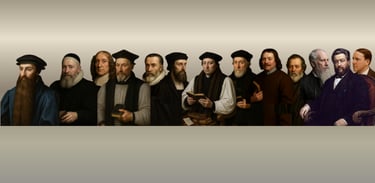
Doctrine Matters
Jeremiah 6:16
“Thus saith the LORD, Stand ye in the ways, and see, and ask for the old paths, where is the good way, and walk therein, and ye shall find rest for your souls. But they said, We will not walk therein.”
King James Version