Amos 7:14 King James Version
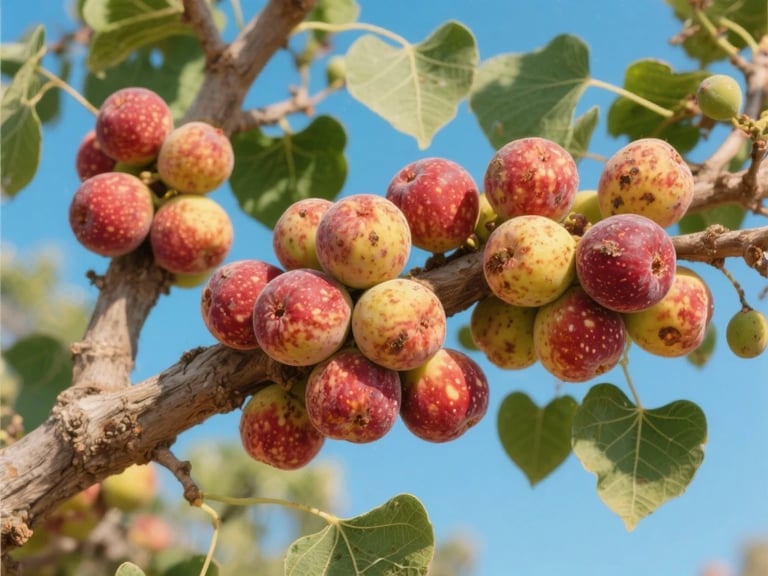
“Then answered Amos, and said to Amaziah, I was no prophet, neither was I a prophet's son; but I was an herdman, and a gatherer of sycamore fruit:”
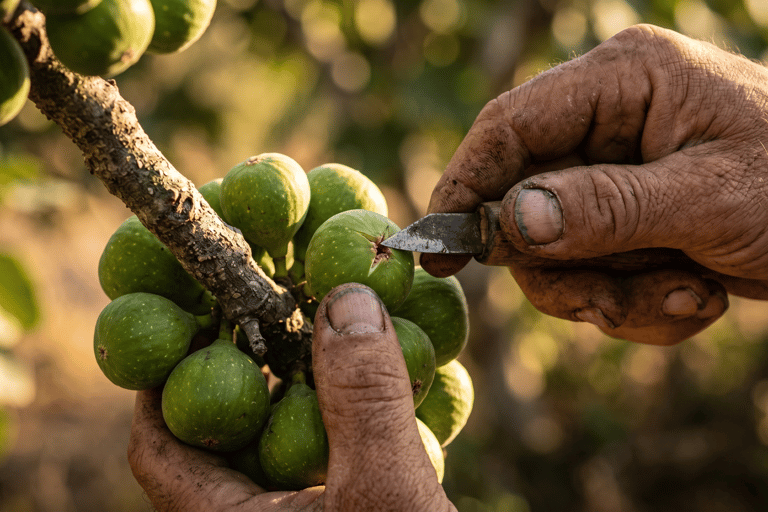
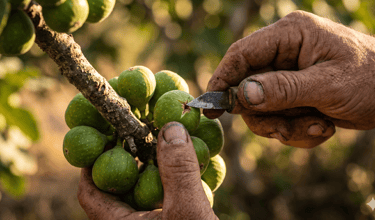
The Hebrew word in question from Amos 7:14 is. בָּלַס (balas)While many English translations, like the King James Version, render it simply as 'a gatherer,' this is an interpretation that misses the specific agricultural action the word describes. Hebrew scholars and lexicographers overwhelmingly agree that the root of the word points to the act of piercing or preparing the fruit. Here are the key references that define this word: Lexical and Concordance References
Strong's Concordance
https://biblestudycompany.com/reader/strongs/1103/hebrew
1103. בָּלַס (balas)
Definition: A pincher (of sycamore figs).
Root: It is derived from an unused root word believed to mean 'to pinch' or 'to squeeze.' Strong's directly connects the word to the specific action performed on the fruit, not just the general act of gathering.
Brown-Driver-Briggs Hebrew and English Lexicon (BDB)
This is a highly respected and more detailed scholarly lexicon. Under the entry for בּוֹלֵס, it defines the term as a participle: 'one who scrapes/slashes sycamore figs.'
The BDB lexicon explains that this refers to the known practice of puncturing the unripe fruit to hasten its ripening. It explicitly rejects 'gatherer' as a primary meaning, seeing it as a secondary consequence of the main job.
The Agricultural Context
These lexical definitions are confirmed by ancient historical and botanical sources. The Greek botanist Theophrastus (c. 371 – c. 287 BC) and the Roman naturalist Pliny the Elder (AD 23/24 – 79) both described this exact practice of scraping or piercing sycamore figs with iron claws to make them ripen. Therefore, when Amos identified himself as a bôlês, he was not just saying he was a humble fruit picker. He was specifying his trade as a skilled, albeit lowly, agricultural worker who performed the essential task of puncturing sycamore figs to make them edible and ready for market. This adds significant weight to his claim of being 'no prophet' but a common working man called directly by God.
The Pierced Fig and the Pierced Saviour: A Typology of Redemption
The act of Amos, the bôlês, is a powerful, earthy metaphor that finds its ultimate fulfilment in the person and work of Jesus Christ. The sycamore fig, in its natural state in that region, was often bitter, hard, and useless. It would not ripen on its own. It required a deliberate, wounding act—a piercing—to interrupt its natural course and initiate a chemical process that would make it soft, sweet, and valuable.
This is a stunning foreshadowing of the Gospel.
As the prophet Isaiah foretold centuries after Amos, the Messiah would be one who was "pierced for our transgressions, he was crushed for our iniquities" (Isaiah 53:5). Humanity, in its sinful state, is like that unripened sycamore fig—hard-hearted, bitter, and unable to produce fruit that is pleasing to God. Left to our own devices, we cannot "ripen" into righteousness. It required a divine and deliberate intervention. The piercing of Christ on the cross was the necessary, wounding act that broke the power of sin and death. Just as the piercing of the fig releases ethylene to trigger ripening, the piercing of Christ unleashed grace, forgiveness, and the power of the Holy Spirit into the world, making it possible for our hard hearts to be softened and our lives to become fruitful.
The Fruit of Repentance: Zacchaeus vs. the Basket of Summer Fruit
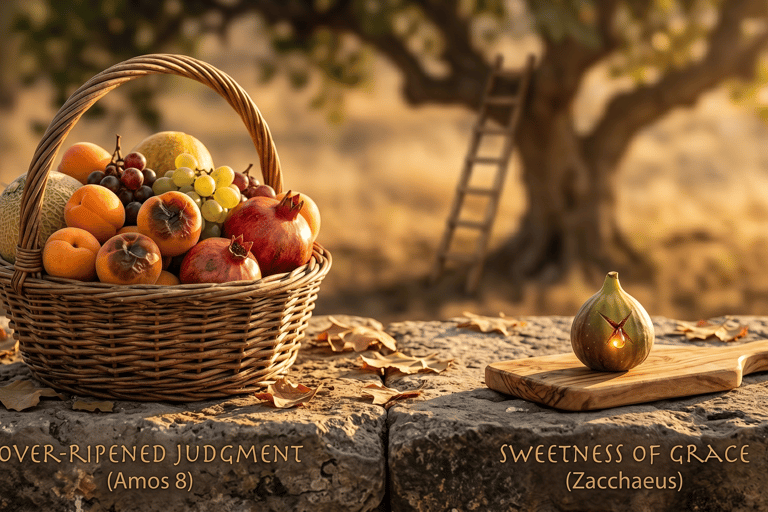
In Luke 19, we find Zacchaeus, a chief tax collector, a man whose life was the very definition of bitter, unrighteous fruit. He was a "sinner" in the eyes of all. And where does he have his life-altering encounter with Jesus? He climbs a sycamore-fig tree. This is no mere coincidence. Zacchaeus, spiritually hard and unripe, places himself in the very tree that symbolizes his condition. When Jesus calls him down, this encounter with grace is the "piercing" of his heart and conscience. The result is immediate and transformative ripening. He declares: "Look, Lord! Here and now I give half of my possessions to the poor, and if I have cheated anybody out of anything, I will pay back four times the amount" (Luke 19:8). This is the very definition of producing "fruit in keeping with repentance" (Matthew 3:8). His life is now soft, sweet, and useful for the ministry of God's kingdom. This stands in stark contrast to the vision God gives Amos just one chapter later: a basket of summer fruit (Amos 8:1-2). When God asks Amos what he sees, He explains, "The end has come for my people Israel." This fruit is also ripe, but it is ripe for judgment. It represents a people who have reached the end of their season of opportunity, whose sin has fully matured, and for whom the harvest of wrath is now due. This presents two paths: we can be like Zacchaeus, allowing the piercing of Christ's truth to ripen us into repentance and usefulness, or we can be like the basket of summer fruit, hardening our hearts until we are ripe only for judgment.
The Rejection of Piercing: The Pride of Isaiah 9:10
This brings us to the powerful and tragic verse highlighted in Isaiah 9:10. In Isaiah 9:10 (KJV), the verse reads: "The bricks are fallen down, but we will build with hewn stones: the sycomores are cut down, but we will change them into cedars". This verse describes a declaration of pride and defiance by the people of Ephraim and Samaria, who, despite facing destruction and having their resources destroyed, boast that they will rebuild with more impressive, man-made materials instead of turning to God. God, in His mercy, had brought a lesser judgment upon the northern kingdom of Israel—symbolized by the felling of the common, utilitarian sycamore trees. This was a divine "piercing," a warning meant to humble them and lead them to repentance. Their response was not humility, but arrogant defiance: “The bricks have fallen, but we will rebuild with finished stone; the sycamores have been felled, but we will replace them with cedars.” This is the voice of the unrepentant heart. They are essentially saying, "Your judgment is insignificant. We don't need you, God. We will rebuild on our own, and we will do it bigger and better than before." They reject the humbling wound intended to save them. They refuse to be softened. By insisting on replacing the lowly sycamore with the lofty, prideful cedar, they are rejecting God's call to repentance and asserting their own strength and sufficiency. This is the spirit that leads to the basket of summer fruit a ripeness for destruction.
Jesus, the First fruit of the Pierced
Finally, all of this culminates in the concept of Jesus as the "first fruit." The Apostle Paul explains, "But Christ has indeed been raised from the dead, the first fruits of those who have fallen asleep" (1 Corinthians 15:20). The first fruit was the first and best part of the harvest, offered to God as a promise and guarantee of the full harvest to come. Jesus, having been pierced on the cross, did not remain wounded. He was resurrected, becoming the first and perfect fruit of a new creation. His resurrection is the guarantee that all who are "in Him"—all who have allowed His piercing to soften and ripen their hearts will also be raised to new life. He is the perfectly ripened fruit, the one who makes our own ripening possible. He endured the piercing so that we, like Zacchaeus, could be called down from our own sycamore trees and be transformed from bitter, useless figs into a sweet, pleasing harvest for God.


Doctrine Matters
Jeremiah 6:16
“Thus saith the LORD, Stand ye in the ways, and see, and ask for the old paths, where is the good way, and walk therein, and ye shall find rest for your souls. But they said, We will not walk therein.”
King James Version