The Architecture of Alignment
No four knock on your door
8/6/20269 min read


The Architecture of Alignment: Calling, Craftsmanship, and the Cross
We’ve all seen human groups collapse. Families drift into quiet distance, leadership teams fracture under minor friction, and lifelong friendships dissolve over misunderstandings. When a team or community breaks down, we tend to look for a single, catastrophic event—an explosive argument, a major betrayal, or a sudden crisis.
The reality is usually much quieter. Human groups rarely collapse overnight; they suffer slow, silent structural decay. Structural integrity fails because we lose our alignment long before the storm hits.
To build something that endures, we must look past the surface noise and understand how true unity functions—and why our words act like operational weapons.
1. The Ultimate Goal: Known by Our Love
In the Christian walk, the ultimate objective of our alignment is not just organizational efficiency; it is unbroken unity expressed through love. Jesus made it clear that our love for one another is the primary identification badge we present to the world. It is the definitive proof of our alignment:
"A new commandment I give to you, that you love one another: just as I have loved you, you also are to love one another. By this all people will know that you are my disciples, if you have love for one another."
— John 13:34–35 (ESV)
Love is not a vague, passive emotion; it is a tactical discipline. It means actively protecting each other’s dignity and walking with one heartbeat.
2. Foot Soldiers Under the King of Kings
When we step onto the battlefield of daily life, we do not march as independent agents or unguided civilians. We walk as foot soldiers in a shared formation under the ultimate supreme authority—Jesus Christ, the King of kings and Lord of lords.
Scripture makes it clear that while worldly rulers and forces wage war, those standing with Him are called, chosen, and faithful:
"They will make war on the Lamb, and the Lamb will conquer them, for he is Lord of lords and King of kings, and those with him are called and chosen and faithful."
— Revelation 17:14 (ESV)
A military unit cannot function if every soldier invents their own orders, picks their own direction, or fights the soldier standing next to them. Alignment requires total submission to our Commander’s voice and absolute unity in the ranks:
"Only let your manner of life be worthy of the gospel of Christ, so that whether I come and see you or am absent, I may hear of you that you are standing firm in one spirit, with one mind striving side by side for the faith of the gospel."
— Philippians 1:27 (ESV)
"Share in suffering as a good soldier of Christ Jesus. No soldier gets entangled in civilian pursuits, since his aim is to please the one who enlisted him."
— 2 Timothy 2:3–4 (ESV)
As foot soldiers serving the King of kings, our objective is clear: stand shoulder-to-shoulder, keep step in the Spirit, and hold the line together.
3. Malachi, Malachy, or Malarkey?
Depending on what side of the fence you sit on, human traditions come and go, but the Word of God stands immutable.
The Old Testament prophet Malachi (Hebrew for "My Messenger") never changes. His words are fixed in Holy Scripture, calling out corrupt priesthoods, hollow ritualism, and fake religious formality.
By contrast, when we look at historical figures like Malachy in 12th-century County Down and the claims surrounding Roman papal consecration, the power of the keys, or human ecclesiastical authority, we face a critical distinction. Where human religious systems attempt to substitute man-made tradition for New Testament authority, Malachy and Malarkey quickly go hand in hand.
The choice in our daily walk comes down to a simple line:
The Messenger (Malachi): Anchored strictly in the immutable Word of God, bringing uncompromised truth, maintaining structural discipline, and keeping step solely with our Commander, Jesus Christ.
Malarkey: Generating careless noise, passing the buck, relying on unauthorized human structures, and indulging in sloppy self-deception.
Malachi remains the unshakeable benchmark. Anything else that claims divine authority without scriptural backing is just malarkey.
4. The Trap of Isolation and Ambush
Predatory forces rarely attack the center of a healthy herd or a disciplined military formation. They run alongside, waiting for a distraction, a misstep, or a sign of weakness. They target the straggler, the weary, and the wanderer who strays from the pack.
This strategy is as ancient as instinct itself:
The Serpent waited until Eve was alone in the garden.
Amalek waited at the rear of the desert march to pick off the weary stragglers.
A treacherous bog waits at the margins to swallow whatever steps off the firm path.
When an individual separates from the flock or the formation, their defense collapses. Staying aligned with your brothers and sisters isn't just a preference—it is your physical and spiritual survival line.
5. Misdirected Strength: Treading on Allies
One of the greatest traps for any team of foot soldiers is misdirected aim. When tension arises, people naturally feel a surge of defensive energy. The tragedy is that we so often direct that energy inward toward our teammates, spouses, or brothers, rather than outward against the real enemy.
Instead of tearing down real strongholds, we end up treading on each other.
"If you bite and devour one another, watch out that you are not consumed by one another."
— Galatians 5:15 (ESV)
If you are aiming your weapons at the person standing right next to you in the trench, you have lost your operational focus. Real alignment requires us to protect the dignity of our allies, ensuring that our strength is always focused outward toward our shared mission, never inward against our brothers and sisters.
6. The Power of Speech: Avoiding Lashon Hara
In Jewish ethical tradition, there is a profound concept known as Lashon Hara (לָשׁוֹן הָרָע), which translates literally to "evil tongue." It refers to speech that is technically true, yet shared carelessly, maliciously, or to tear someone down behind their back.
Unlike outright lying, Lashon Hara is particularly dangerous because it wraps itself in the cloak of truth. It spreads gossip under the guise of "concern" or "just sharing the facts." But ancient wisdom treats destructive speech not as a minor flaw, but as a primary cause of structural damage in a community.
Consider how Scripture describes the tongue:
"How great a forest is set ablaze by such a small fire! And the tongue is a fire, a world of unrighteousness. The tongue is set among our members, staining the whole body, setting on fire the entire course of life, and set on fire by hell."
— James 3:5b–6 (ESV)
When we indulge in careless talk, we act as a destructive force within our own camp. We loosen the joints of trust that keep us together.
7. The Danger of Willful Blindness
One of the most severe warnings in Scripture concerns those who claim to have perfect spiritual sight while harboring self-deception and corruption.
When people insist on keeping their own pride, double standards, and worldly baggage while claiming to walk in God's light, they fall into willful blindness. Claiming "we see" while treading on our allies and spreading gossip only cements our guilt. True sight requires stepping into the humbling light of truth, dropping our pride, and letting God realign our eyes.
8. The Made-to-Measure Fit: The Draft Collar, Human Armor, and the Yoke
In a working team of draft horses, harmony is never created by interchangeability. Though a matched hitch moves as one, every single horse requires its own individually fitted draft collar, molded over time through labor and sweat. A variation of just one inch—or forcing one animal to wear another’s gear—causes immediate choking at the throat and bone-deep sores on the shoulders.
So it is when we try to walk in our calling while dragging along the corrupt weight of the world’s system or squeezing into someone else's armor. King Saul tried to put his heavy armor on David, but it chafed and bound him because it was measured for Saul's stature, not David's walk (1 Samuel 17:38–39). Human armor only protects the flesh; it cannot transform the bearer.
Jesus said:
"Take my yoke upon you, and learn from me, for I am gentle and lowly in heart, and you will find rest for your souls. For my yoke is easy, and my burden is light."
— Matthew 11:29–30 (ESV)
The yoke of Christ is "easy" because it is made to measure—custom-carved to fit the individual’s shoulders perfectly so the burden is balanced. But when people try to stuff that tailored yoke with the world’s baggage, status, and gossip, it alters the geometry of the fit. To force conscience into human religious systems or worldly standards is like wearing an ill-fitting collar—it chafes, chokes, and digs into raw flesh.
Like a complex piece of machinery or a team of draft horses, every part must stay in its designated, tailor-made position under Christ. Disrupt that placement, and the system becomes instantly dysfunctional.
9. The Art of the Bell: A Clear, Unbroken Ring
When a message or a life is out of alignment, it loses its clarity. In ancient warfare and church tradition, casting a bell to ring a distinct note required extraordinary craftsmanship:
The Furnace and Alloy: A bell cannot be made of soft or impure metal. Any hidden air bubbles or cheap impurities in the molten bronze will cause hairline fractures, turning a glorious tone into a dull, thudding sound when struck.
Tuning by Stripping Away: Bell founders do not tune a bell by adding metal; they tune it by mounting it on a lathe and shaving thin ribbons of bronze off the inside wall.
God does not tune our lives by adding worldly status, heavy human armor, or self-righteous pride. He tunes us by taking away—carving out self-reliance, vanity, and double-mindedness until our inner resonance aligns with the Cross. Only then do we give off a clear, distinct alarm:
"And if the bugle gives an indistinct sound, who will get ready for battle?"
— 1 Corinthians 14:8 (ESV)
10. The Master Architecture of Unity: Ya'ad, Harmonia, and Homothumadon
To understand what true unity looks like, we have to contrast the breakdown of speech with the rich word associations found in ancient languages regarding agreement and shared pitch.
The Pitch of Agreement (Ya'ad)
In the Old Testament, the Prophet Amos asks a fundamental question about alignment:
"Do two walk together, unless they have agreed to meet?"
— Amos 3:3 (ESV)
The Hebrew word often translated as "agreed" carries the sense of Ya'ad—to fix a time, set an appointment, or come to a precise reference point. Think of musicians tuning their instruments before playing. If two instruments are tuned to completely different reference pitches, playing together produces immediate discord, no matter how skilled the musicians are. Ya'ad is the deliberate act of getting on the exact same pitch before stepping out on the road together.
The Fitting Joint (Harmonia)
This leads directly into the Greek concept of Harmony (Harmonia – ἁρμονία). In modern language, we think of harmony purely as a musical term—different notes sounding beautiful together. But in the ancient world, harmonia wasn't originally about music at all. It was a trade word used by carpenters, stonemasons, and shipbuilders. It meant a "tight joint," a "peg," or the exact fitting together of two separate timber beams so tightly that water couldn't pass between them.
In human relationships, true harmony isn't unison (everyone playing the exact same note); it is distinct individuals fitting together so tightly in structure and spirit that no wedge can drive them apart.
One Mind, One Passion (Homothumadon)
When we look at the early church in the New Testament, we see the result of that shared pitch and structural fitting described with the Greek word Homothumadon (ὁμοθυμαδόν). It appears repeatedly in the Book of Acts to describe the believers gathering with "one accord" or "one mind."
Homothumadon is a compound word: homos (meaning "same") and thumos (meaning "passion, breath, or fierce desire"). It describes a group of individuals moving with a single heartbeat and a unified breath.
"And all who believed were together and had all things in common."
— Acts 2:44 (ESV)
"Now the full number of those who believed were of one heart and soul..."
— Acts 4:32a (ESV)
11. Don't Be a Sausage: The Test of Integrity
So why the title Don't Be a Sausage?
Across various languages and cultural slang, the humble sausage is frequently used to describe human weakness, sloppiness, or a total lack of backbone:
In Israeli Hebrew slang, calling someone a naknik (נקניק – sausage) means they are a wimp, a pushover, or unreliable under pressure.
In German idiom, saying "Es ist mir Wurst" ("It is sausage to me") means "I don't care"—it represents complete apathy and indifference.
To "be a sausage" is to lack structural integrity. It means sagging under pressure, allowing careless speech to run wild, and treating the unity of your community with complete apathy.
By contrast, true integrity requires being accurate. The root of accurate comes from accurare—taking care, and treating the truth, your words, and your relationships with deliberate precision.
Strategic Protocol for Soldiers of the King
If we want to build homes, teams, and churches that stand firm through any storm, we must commit to five basic principles:
Audit Your Speech: Cut out damaging talk (Lashon Hara). Refuse to pass along information that tears down an ally, even if it is technically true.
Beware Willful Blindness: Don't claim "we see" while ignoring your own blind spots. Let the truth realign your sight daily.
Correct Your Target: Direct your strength outward against real problems. Never aim your weapons inward at your fellow foot soldiers.
Execute Love as a Discipline: Make love your defining mark (John 13:35). Real unity is a daily decision to protect each other’s dignity under the King of kings.
Tune Before You Play: Get on the same reference pitch (Ya'ad) and fit tightly together (Harmonia) so you can move forward in true, unbroken harmony (Homothumadon).
Footnote: On Sausages, Sloths, and Language
Linguistically speaking, "sloth" is simply the archaic noun form of "slow" (historically "slowth," matching the grammatical pattern of deep/depth or wide/width). While Spanish criminal slang historically used chorizo to refer to a thief, Hebrew slang uses naknik (sausage) to describe a wimp, and German uses Wurst (sausage) to express complete apathy. Whether describing thieves, weakness, or slow-moving mammals, human language routinely relies on the sausage to describe a lack of backbone. Don't be one.

Doctrine Matters
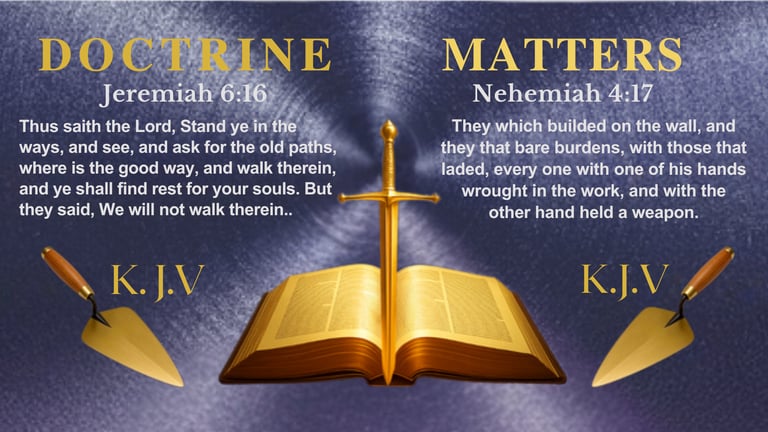
Jeremiah 6:16
“Thus saith the LORD, Stand ye in the ways, and see, and ask for the old paths, where is the good way, and walk therein, and ye shall find rest for your souls. But they said, We will not walk therein.”
King James Version