The Digital Pied Piper
7/27/20269 min read


Algorithmic Portals, Youth Corruption, and the Battle for the Next Generation
In 1990, the Evangelical Alliance released a landmark documentary project titled Doorways to Danger, featuring minister Kevin Logan and other UK Christian leaders. Grounded in Deuteronomy 18:10–12, the film warned that spiritual compromise rarely enters through open rebellion. Instead, it enters through subtle, seemingly harmless openings—Ouija boards, horoscopes, tarot cards, séances, and casual dabbling in the occult—where curiosity leads to invitation, and invitation leads to spiritual oppression.
"There shall not be found among you any one that maketh his son or his daughter to pass through the fire, or that useth divination, or an observer of times, or an enchanter, or a witch, or a charmer, or a consulter with familiar spirits, or a wizard, or a necromancer. For all that do these things are an abomination unto the LORD"
— Deuteronomy 18:10–12 (KJV)
In the opening minutes of the documentary, Rev. Logan introduces his companion book, Paganism and the Occult, published by Kingsway Publications. The core message was clear: what a culture treats as harmless fun often masks a deeper spiritual hazard.
Thirty years later, those physical entry points have evolved into always-on digital portals sitting directly in the hands of our children.
The underlying spiritual mechanics remain identical: curiosity, desensitization, and ideological capture. However, the delivery mechanism has shifted from physical objects used occasionally in groups to frictionless, personalized algorithms operating 24 hours a day in private, unmonitored bedrooms. Today, the doorway isn't sitting in a dark closet—it's glowing in your child's hand.
1. The Science Behind the Trap: "TikTok Brain" & The Dopamine Loop
The legendary Pied Piper used a sweet, hypnotic melody to lure an entire generation of children away from their families. Modern short-form video platforms operate on the exact same principle, substituting hypnotic tunes with artificial intelligence engineered to exploit human neurobiology.
Scripture instructs us:
"Keep thy heart with all diligence; for out of it are the issues of life."
— Proverbs 4:23 (KJV)
Yet psychological and neuroscientific research explains why children and adolescents are uniquely vulnerable to having their minds captured by this modern "Pied Piper":
Asymmetric Brain Development: In young people, the reward centers of the brain mature much earlier than the prefrontal cortex—the region responsible for impulse control, discernment, and long-term planning.
The Slot-Machine Effect: Algorithms use variable-ratio reinforcement schedules. Because a child never knows if the next 15-second video will be entertaining, every swipe releases a burst of dopamine. Without a fully developed prefrontal cortex to say "that is enough," stopping becomes nearly impossible through self-control alone.
Attentional Fragmentation: Continuous exposure to rapid, hyper-stimulating clips conditions young minds to expect constant novelty, reducing attentional stability for slower, effort-heavy tasks like reading Scripture, studying, or quiet reflection.
Emotional Volatility and Dopamine Crashes: The rapid drop in stimulation when transitioning from screens back to the real world frequently causes acute irritability, anxiety, and screen-transition fatigue.
The "If You Were the Devil" AI Trend
A stark real-world illustration of this phenomenon is the viral social media trend where creators share AI-generated responses to the prompt: "If you were the devil, how would you destroy the next generation?" I actually tried it and defiantly don't recommend that you do, its a case of be advised
The AI’s generated blueprint mirrors C.S. Lewis’s The Screwtape Letters with chilling accuracy:
Severing Presence: Fragmenting attention spans with endless content so quiet, prayerful reflection becomes impossible. "Be still, and know that I am God" (Psalm 46:10, KJV) is replaced by endless noise.
Corrupting Truth: Flooding young minds with information while starving them of biblical wisdom and critical thinking. They are "ever learning, and never able to come to the knowledge of the truth" (2 Timothy 3:7, KJV).
Commodifying Worth: Forcing youth to measure their value via digital metrics—likes, views, and aesthetic perfection—rather than knowing they are "fearfully and wonderfully made" (Psalm 139:14, KJV).
Normalizing Despair: Feeding vulnerable youth dark, romanticized content regarding self-harm and hopelessness when they show the slightest sign of emotional distress. "The thief cometh not, but for to steal, and to kill, and to destroy" (John 10:10, KJV).
What began as an AI thought experiment serves as an accurate diagnosis of the modern media landscape: systemic, comfortable distraction designed to rot minds quietly under the guise of freedom.
2. The Evidence: Judicial Rulings and Human Tragedy
The mental and spiritual harm caused by these algorithmic portals is documented in landmark judicial rulings across Britain, Europe, and the United States:
The Inquest of Molly Russell (United Kingdom): Senior Coroner Andrew Walker issued a historical ruling that 14-year-old Molly Russell died from an act of self-harm while suffering depression and the negative effects of online content. Court records proved that algorithms on Instagram and Pinterest served her over 2,100 unrequested posts romanticizing suicide and self-harm in her final months.
The French Collective Lawsuit (Algos Victima): Seven French families united at the Créteil Judicial Court to sue TikTok after its recommendation algorithm continuously pushed self-harm and suicide content to teenage girls, directly resulting in two tragic suicides.
The U.S. Landmark Verdict (K.G.M. v. Meta & Google): A California jury awarded $6 million in damages to a young woman, holding tech giants legally negligent for designing addictive features that drove minors into severe depression and self-harm ideation.
3. Roblox, Modern Games, and Mainstream Media
The digital doorway extends far beyond social media feeds into platforms many parents assume are harmless sandbox entertainment:
Roblox and Decentralized Gaming: While marketed as a child-friendly game, Roblox functions as an unmoderated social network. Unmoderated user-created rooms feature adult horror tropes, dark-web creepypasta lore like The Backrooms, gambling mechanics via Robux, and open-chat environments targeted by bad actors.
Occult Tropes in Modern Gaming: Modern youth gaming heavily integrates witchcraft, demonology, and spellcasting as core mechanics. Where classic warnings highlighted fantasy role-playing games, modern video games make occult ritual participation interactive, aesthetic, and instant.
Mainstream Entertainment Shift: Mainstream channels, including traditional family brands like Disney, frequently promote moral relativism ("follow your own heart" rather than "Trust in the LORD with all thine heart" — Proverbs 3:5, KJV), the normalization of witchcraft, and the framing of parental authority as an obstacle to true identity.
As Paul warns:
"Lest Satan should get an advantage of us: for we are not ignorant of his devices."
— 2 Corinthians 2:11 (KJV)
4. Spiritual Ramifications: What Is at Stake?
The goal of this multi-faceted media ecosystem is not merely to sell products—it is a spiritual confrontation for the heart, mind, and worldview of the next generation.
"For we wrestle not against flesh and blood, but against principalities, against powers, against the rulers of the darkness of this world, against spiritual wickedness in high places."
— Ephesians 6:12 (KJV)
The fruit of this digital saturation is visible across society:
Mental Health Crises: Unprecedented levels of anxiety, depression, self-harm ideation, and identity confusion among pre-teens and teenagers.
Biblical Illiteracy: A generation that can spend 5 hours a day consuming short-form video, but struggles to read or comprehend Scripture. "My people are destroyed for lack of knowledge" (Hosea 4:6, KJV).
Apathy Toward God: Replacing a living relationship with the Creator with passive consumption of digital idols, leaving youth "lovers of pleasures more than lovers of God" (2 Timothy 3:4, KJV).
Scripture reminds us: "Be not conformed to this world: but be ye transformed by the renewing of your mind, that ye may prove what is that good, and acceptable, and perfect, will of God" (Romans 12:2, KJV).
5. Returning to the Roots: Messianic Jewish Thought vs. Western Algorithmic Culture
To fully understand how modern digital culture distracts and fragments young minds, it is illuminating to contrast the modern Western mindset with the foundational principles of Messianic Judaism—Jewish believers who recognize Yeshua (Jesus) as the promised Messiah of Israel.
Where the Western digital ecosystem promotes isolation, instant gratification, and self-manufactured identity, the Messianic Jewish worldview offers an ancient, biblically rooted counterweight built on covenant, community, and sacred rhythm.
Individualism vs. Covenant Community
Modern social media and algorithmic feeds isolate the individual. Validation is gamified through quantified metrics—likes, followers, and aesthetic perfection. Identity is treated as something self-created, fragile, and constantly open to public review.
In contrast, the Messianic ideal grounds identity in Covenant (Berit). A person's worth is not performed for an online audience; it is established by God as an image-bearer: "So God created man in his own image, in the image of God created he him; male and female created he them" (Genesis 1:27, KJV). Spiritual growth happens in physical, intergenerational communities where elders, parents, and youth worship and study together, rather than in age-segregated digital silos.
Algorithmic Frenzy vs. The Gift of Shabbat
The modern Western world operates on a 24/7 cycle of continuous consumption, notification, and stimulation—an environment where quiet reflection becomes almost intolerable. The smartphone ensures that silence is immediately filled with a scroll, training the mind to tolerate zero downtime.
In contrast, Messianic practice preserves the biblical commandment of Shabbat (the Sabbath): "Remember the sabbath day, to keep it holy. Six days shalt thou labour, and do all thy work: But the seventh day is the sabbath of the LORD thy God" (Exodus 20:8–10, KJV). Shabbat creates a sanctuary in time—a physical, household boundary where screens are put away, families gather around a table, and minds are recalibrated through prayer, scripture, and shared meals from Friday evening to Saturday evening.
Information Saturation vs. Chochmah (Wisdom)
Modern algorithms flood young people with endless streams of short-form information, yet produce unprecedented levels of anxiety and spiritual confusion. Consuming thousands of 15-second video clips daily prioritizes novel, emotionally charged content over lasting truth.
The Messianic ideal centers on the pursuit of Wisdom (Chochmah) and the meditative study of Scripture: "Wisdom is the principal thing; therefore get wisdom: and with all thy getting get understanding" (Proverbs 4:7, KJV). Rather than skimming surface-level trends, believers are called to chew on God's Word, testing every idea against eternal truth: "These were more noble than those in Thessalonica, in that they received the word with all readiness of mind, and searched the scriptures daily, whether those things were so" (Acts 17:11, KJV).
6. Action Plan for the Household
"Let us hear the conclusion of the whole matter: Fear God, and keep his commandments: for this is the whole duty of man."
— Ecclesiastes 12:13 (KJV)
Scripture calls parents and elders to be watchful shepherds of their households: "Be sober, be vigilant; because your adversary the devil, as a roaring lion, walketh about, seeking whom he may devour" (1 Peter 5:8, KJV).
Because a child's brain cannot resist algorithmic conditioning on its own, adults must step into their biblical calling in Deuteronomy 6:6–7 and supply the structural boundaries required by God's Word:
"And these words, which I command thee this day, shall be in thine heart: And thou shalt teach them diligently unto thy children, and shalt talk of them when thou sittest in thine house, and when thou walkest by the way, and when thou liest down, and when thou risest up."
— Deuteronomy 6:6–7 (KJV)
Practical Steps for Parents & Grandparents:
Apply External Friction: Remove all screens and smartphones from bedrooms overnight. Relying on a child's self-control against a billion-dollar algorithm will always fail.
Network Protection: Install router-level internet filtering across the home to block predatory domains and unmonitored social platforms.
Audit Gaming & Social Apps: Delete unmonitored apps like TikTok and unmoderated gaming platforms like Roblox for younger children.
Teach Digital Literacy: Explain to children how algorithms work so they recognize that platforms are actively designed to hijack their attention.
Replace, Don't Just Ban: You cannot defeat a digital habit with mere willpower; you must replace it with a richer, biblically grounded culture. Provide a biblical counterweight by replacing hours of passive screen consumption with consistent family prayer, Scripture reading, and physical offline fellowship. "Train up a child in the way he should go: and when he is old, he will not depart from it" (Proverbs 22:6, KJV).
Build Household Sanctuaries: Restore physical boundaries like family meal times, intentional days of rest (Sabbath principle), and deep scriptural study.
Spiritual Intercession & Mind Protection: Shielding children from the predatory noise of modern media anchors them in timeless, living truth: "Thou wilt keep him in perfect peace, whose mind is stayed on thee: because he trusteth in thee" (Isaiah 26:3, KJV). Exercise parental authority through daily prayer over your children's minds and identity, taking "captivity every thought to the obedience of Christ" (2 Corinthians 10:5, KJV).
What we allow through our homes' digital doorways will inevitably shape the hearts of our children. Let us stand in the gap today.
Additional Resources & Historical Context
You can watch the original 1990 Doorways to Danger documentary on YouTube at https://www.youtube.com/watch?v=c_pp1d8Ugts for historical context on how these warnings began.
Footnote: Modern Video Resources & Visual Evidence
For visual documentation and deep-dive investigative reporting on how these concepts manifest in today's media landscape, consider these three modern video equivalents that illustrate how the themes from the 1990 Doorways to Danger documentary have evolved into today’s digital portals:
The Algorithmic Doorway & Youth Impact:
https://www.youtube.com/watch?v=CbNmN3rcZ6k
TikTok's Algorithm Sends Kids Suicide Content (Bloomberg Investigates) — This feature investigation demonstrates how modern short-form video algorithms track user hesitation, leading pre-teens down extreme, self-reinforcing spirals of despair and self-harm content.
How the "Digital Pied Piper" Functions:https://www.youtube.com/watch?v=nfczi2cI6Cs&t=1s
How TikTok's Algorithm Figures You Out (The Wall Street Journal) — A technical breakdown showing the exact mechanics behind short-form algorithms, revealing how proprietary systems exploit a child's vulnerabilities purely through watch time and engagement loops.
The Full Feature on Social Media's Threat to Youth
:https://www.youtube.com/watch?v=He3IJJhFy-I&t=2s
Childhood 2.0 (Full Documentary) — A comprehensive documentary exploring how the modern digital ecosystem acts as a primary threat to youth mental, emotional, and spiritual health, examining algorithmic addiction, online grooming, and the decline of offline childhood.


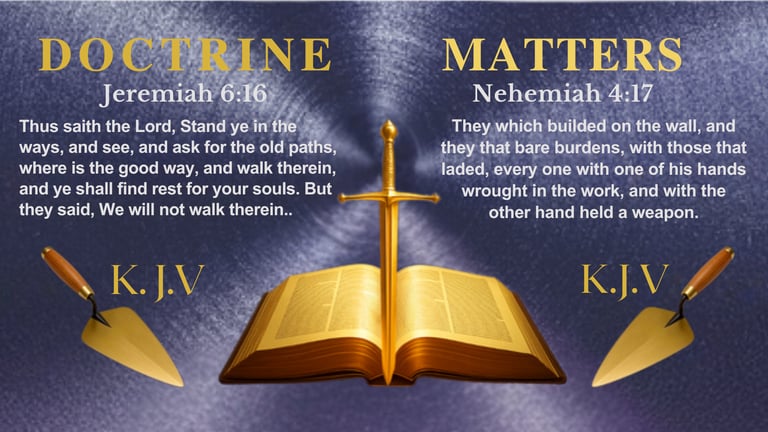
Doctrine Matters
Jeremiah 6:16
“Thus saith the LORD, Stand ye in the ways, and see, and ask for the old paths, where is the good way, and walk therein, and ye shall find rest for your souls. But they said, We will not walk therein.”
King James Version