The Gnosis of Prognosis
7/26/202611 min read


The Gnosis of Prognosis
Even after a few pages devoted to explaining my Medical journey I feel the need to bring it all up to date. My next major consultation will be on the 4th August, I've committed this to the lord I believe I know the outcome. Sometimes I put so many fleeces out that I don't know which one should be wet and which one should be dry. Even before I came to the lord my life was inexplicably spared on a few occasions. But that's for my B.C testamony.
A Journey of Faith and Survival:
Personal Caveat & Disclaimer
"Who art thou that judgest another man's servant? to his own master he standeth
or falleth... Let every man be fully persuaded in his own mind... So then every
one of us shall give account of himself to God."
— Romans 14:4-5, 12 (KJV)
A Note on My Personal Walk: The reflections, decisions, and convictions shared here are strictly a record of my personal journey and faith walk with the Lord. They are not intended as medical advice, a theological blueprint, or a prescription for anyone else's life or health. God leads each of us uniquely, and what He requires or reveals in my personal walk may not be His path for another. I deeply respect the medical community, the individual journeys of others, and the need for each person to seek the Lord’s specific direction for their own life alongside proper counsel.
The Prelude: The Balance of Faith
“He who dwells in the shelter of the Most High will rest in the shadow of the Almighty.” — Psalm 91:1
The journey began in 2019 with my first heart attack. That cardiac crisis marked the start of a seven-year journey through the valley of death's shadow. What made the years that followed so grueling was that I was still in the middle of recovering from that first heart attack when the emergency abdominal surgery, the burst abdomen, and the surgical battles all began to hit at once.
For years, I used to work with my hands in building maintenance, analyzing structures, foundations, and faults. Today, after everything my body and heart have endured, I find myself working with something far different: my heart—my renewed heart ."Search me, O God, and know my heart: try me, and know my thoughts: And see if there be any wicked way in me, and lead me in the way everlasting."— Psalm 139:23-24 (KJV
Walking the Tightrope:
Genuine Faith vs. Presumption
“Trust in the Lord with all your heart and lean not on your own understanding; in all your ways submit to him, and he will make your paths straight.” — Proverbs 3:5–6
I often view my faith like a tightrope walker or a scale balance. On one side, I firmly reject the "Word of Faith" movement—the "blab-it-and-grab-it," "1-2-3-believe-after-me," name-it-and-claim-it theology that treats God like a vending machine.
We saw the tragic extreme of this theology in December 2019, when leaders and parents at Bethel Church attempted to publicly command the physical resurrection of two-year-old Olive Heiligenthal for days after she had passed away. That movement creates untold spiritual damage because its underlying premise is cruel: if you aren't healed, it's your fault for not having enough faith. This incident sticks in my mind particularly because, at that time, I was in the midst of my own recovery from a heart attack, which made the spectacle of public demands for miracles feel especially jarring while I was fighting for my own survival.
I do not believe we can manipulate God with positive proclamations or force our will into existence. True faith is not about declaring what we want and demanding God sign off on it. True faith is about discerning His voice, aligning with His Word, and remaining standing even when medical logic says you shouldn't be here.
There is a vast difference between reckless presumption and spiritual conviction. When I made decisions like declining TPN treatment to break free from high-risk central lines, it wasn't a reckless stunt or a "claim" of healing—it was a deeply prayed-over conviction. As Scripture reminds us, the unrenewed human heart is deceitful above all things. You must be 100% certain the Lord directs a step of faith, not driven by your own ego or desire.
I do refuse negative prognostic declarations spoken over my life unless my Father in heaven acknowledges them. But my ultimate prayer is never a demand. It is the simple prayer Christ taught us: "Thy will be done."
Where I Stand Today:
Awaiting Reconstructive Surgery
“But those who wait on the Lord shall renew their strength; they shall mount up with wings like eagles...” — Isaiah 40:31
Following my move to Northern Ireland, my surgical care was transferred to a Consultant Surgeon to evaluate rebuilding my abdominal wall and restoring my digestive continuity.
My recent consultation laid bare the staggering scale of what lies ahead: a 12-hour, multidisciplinary operation involving general surgeons, specialists, and a plastic surgery registrar to rebuild the four-inch gap where my abdominal wall is completely missing. It will mean high-dependency care, a potential return to TPN, or a stoma.
Medically, I am caught in a paradox. One doctor tells me I must have the operation to stop the constant threat of recurring sepsis. Another warns that I might not survive the 12-hour strain because my body—already carrying the weight of cardiac history, kidney disease, and damaged lungs—isn't physically fit enough yet. On paper, it looks like a no-win situation.
I have immense respect for the medical professionals who have kept me alive, but my life does not belong to statistics or medical paradoxes. I am not panicked by the risks, nor am I trying to "speak" an outcome into existence.
I am simply standing on the tightrope of faith—working with my renewed heart, using spiritual discernment, and waiting on what the Lord says to me. Whether on the operating table or on the ward, my life is securely in His hands.
The Ongoing Battle:
Awaiting Physical Restoration
(2021–Present)
Living with the Fistula
“My times are in your hands...” — Psalm 31:15
Following my emergency surgery and the "burst abdomen" of 2020—all while I was still trying to recover from my first heart attack—I was left with an enterocutaneous fistula that produces high-volume fluid daily. Living with an open abdominal wound and an unsealed digestive system on top of a healing heart requires constant physical endurance and daily care.
The Surgical Referral
Upon moving from England to Northern Ireland, my ongoing surgical care was transferred. From an English Consultant Surgeon to a Northern Irish one to explore the possibility of a major operation to repair my abdominal wall and achieve a "restoration of continuity" for my bowel.
Reconstructive surgery of this complexity carries extreme risk, especially given my cardiac history, kidney disease, and repeated severe lung infections. Detailed CT scans were performed to evaluate the adhesion of my bowel loops to the thinned abdominal wall.
Standing in Faith
The procedure has been deferred simply because my body has not yet been physically fit or strong enough to withstand such a massive operation. I remain on the surgical path, holding fast to faith while waiting for my body to regain the strength required for this final stage of physical restoration.
The Humanly Impossible Path:
Faith Beyond the Diagnosis
The Reality of Operating
“Who has believed our report? And to whom has the arm of the Lord been revealed?” — Isaiah 53:1
My most recent discussion with my surgeon laid bare the true scale of what lies ahead. Rebuilding my abdominal wall isn't a routine procedure—it requires a complex, multi-hour operation (likely around 12 hours) involving a team of surgeons, specialists, and a plastic surgery registrar to reconstruct the four-inch gap where my stomach wall is completely gone. I have been prepared for high-dependency convalescence, a potential return to TPN, or even a stoma.
The Medical Paradox
The body is currently unfit to survive the 12-hour strain given cardiac history, kidney disease, and lung damage.
Refusing Negative Proclamations
“The tongue has the power of life and death, and those who love it will eat its fruit.” — Proverbs 18:21
But my ultimate trust does not rest in human statistics. Years ago, the Lord taught me a vital principle about the power of spoken words over our lives. I observed how easily people accept a terminal timeline spoken by a doctor and subsequently pass away right on schedule. I refuse to accept any negative proclamation over my life unless my Father in heaven acknowledges it.
True Faith vs. Human Will
“The heart is deceitful above all things and beyond cure. Who can understand it? I the Lord search the heart...” — Jeremiah 17:9–10
Having a high regard for the medical profession doesn't mean blindly accepting every prognosis. There have been pivotal moments—like my decision to stop TPN treatment—where I had to go against medical advice. However, a major leap of faith like that isn't something to be taken lightly or out of self-will. As Scripture reminds us, the unrenewed human heart is deceitful. You must be 100% certain the Lord truly directs a decision and not just the desires of your own mind.
Waiting on the Lord
“This is what the Lord says: 'Stand at the crossroads and look; ask for the ancient paths... and walk in it, and you will find rest for your souls.'” — Jeremiah 6:16
As I stand at this crossroad, I am not panicked by the risks or paralyzed by the medical paradox. I am simply waiting on what the Lord says to me, knowing that my times are securely in His hands.
Reflections on Modern
Faith & Accountability
Standing on the tightrope of faith requires a delicate balance between absolute trust in the Divine and a sober awareness of human fallibility. My personal journey has taught me that true faith never bypasses accountability or reality; rather, it anchors itself in a peace that transcends medical prognosis without descending into reckless presumption. This distinction is vital, for when faith is decoupled from integrity and used as a tool for institutional preservation, it ceases to be a refuge and becomes a mechanism for exploitation. By examining the intersection of personal conviction and corporate religious culture, we can begin to see where the sacred duty of pastoral care is often sacrificed on the altar of brand management.
Anatomy of a Tragedy:
The Bethel Case
“Dear friends, do not believe every spirit, but test the spirits to see whether they are from God, because many false prophets have gone out into the world.” — 1 John 4:1
In December 2019, a devastating personal tragedy was transformed into a week-long, global media spectacle. When two-year-old Olive Alayne Heiligenthal stopped breathing in her sleep, her body was taken to a local hospital, pronounced dead, and transferred to the Shasta County coroner's office.
What should have been a period of solemn grieving for parents Andrew and Kalley Heiligenthal instead became the stage for a viral campaign (#WakeUpOlive) to command a dead child back to life.
Driven by Bethel Church—a multi-million dollar charismatic megachurch headquartered in Redding, California—the movement brought global media scrutiny, fierce theological rebuke, and severe ethical questions. Behind the rhetoric of "unshakable faith" lay a system of spiritual gaslighting, corporate damage control, and financial incentives that prioritized a religious brand over raw human grief.
1. The Crucible:
Denying Reality as a Sacred Act
Within hours of their daughter’s death, Kalley Heiligenthal—a high-profile worship leader and songwriter for Bethel Music—posted an urgent plea to her hundreds of thousands of Instagram followers: "Her time here is not done... It’s time for her to come to life."
For nearly a week, Bethel Church hosted public prayer, music, and worship gatherings specifically demanding that the child's body wake up and return home. Senior Pastor Bill Johnson released videos defending the corporate prayers, citing New Testament accounts of Jesus raising the dead and asserting that Christians are commanded to do the same.
The reality gap was staggering: while a two-year-old child lay deceased in the county coroner's morgue, church leaders claimed she was simply "asleep" and would wake up if collective faith was strong enough.
Rather than offering pastoral care grounded in reality, the church leaned into hyper-charismatic "Word of Faith" theology. In this framework, human words hold creative power: to express doubt or acknowledge death is framed as a lack of faith, while publicly declaring a miracle is treated as spiritual obedience.
Grief counselors and theologians quickly pointed out the psychological cruelty of this practice. For six straight days, a grieving mother and father were encouraged to shout commands at a corpse while thousands cheered them on online. By treating physical reality as a mere obstacle of "weak faith," the church prolonged the parents' acute trauma and delayed the necessary closure of mourning.
2. Spiritual Gaslighting:
How the System Shifts the Blame
When a prophesied miracle fails on a global stage, a megachurch cannot easily admit its core theology is flawed. To do so would collapse the foundation of its brand. Instead, hyper-charismatic leadership deploys spiritual gaslighting—manipulating the perception of reality so that followers doubt their own eyes rather than questioning the doctrine.
When it became undeniable that Olive would not be raised, Bethel officially called off the resurrection gatherings on December 20, 2019. Their public statements immediately executed a series of narrative pivots:
Reframing Failure as Victory: The church’s public statements declared gratitude that "faith, hope, and love have been the response," framing a devastating failure as a beautiful showcase of global unity.
Moving the Goalposts: Leadership shifted from demanding a physical awakening to claiming Olive had been "resurrected spiritually in heaven." Followers who had spent days praying for a physical miracle were subtly corrected into believing that "heavenly homecoming" was the intended answer all along.
Weaponizing Faith Against the Doubter: In Word of Faith circles, the burden of a failed miracle is almost always shifted onto the individual or the crowd. If the miracle didn't happen, the silent implication is that there was hidden doubt, insufficient unity, or a lack of collective faith—absolving the leadership and theology of any error.
3. The PR Playbook: Institutional Damage Control
As secular journalists and mainstream theologians condemned the event as a dangerous spectacle, Bethel’s corporate PR apparatus deployed classic damage control tactics to insulate the institution.
First, they normalized the extremism by framing prayers for a corpse as standard "outlandish, child-like faith," which insulated leadership from charges of reckless emotional manipulation.
Second, they shifted ownership of the movement, framing the event as a private choice by a grieving mother that the church merely "supported." This created a structural escape hatch: if the resurrection succeeded, the church could take credit; if it failed, it was categorized as just a mother's personal grief.
Finally, they rebranded the tragedy by publicly declaring "God wastes nothing" and pivoting to a celebration of life. This transitioned the narrative quickly to suppress lingering questions or demands for structural accountability.
4. The Financial Engine: Monetizing the "Signs and Wonders" Economy
The most glaring injustice of the #WakeUpOlive campaign was the intersection of viral tragedy, corporate branding, and financial crowdfunding.
The GoFundMe Dissonance: While thousands prayed for a resurrection, a GoFundMe campaign was launched, rapidly raising over $70,000 for "unforeseen medical and funeral expenses." Critics pointed out the jarring cognitive dissonance: if leadership truly believed a physical miracle was hours away, why collect tens of thousands of dollars for a funeral beforehand?
Protecting the Music Label: Kalley Heiligenthal was not an obscure member. She was a core financial and creative asset for Bethel Music—a record label generating millions globally in streaming, licensing, and touring. Admitting that "decreeing and declaring" life into a corpse was a delusion would directly damage the credibility and marketability of Bethel’s music empire.
Sustaining the BSSM Model: The Bethel School of Supernatural Ministry (BSSM) charges tuition to thousands of students annually under the premise that they can be taught to perform modern miracles, healings, and prophecies. The entire commercial ecosystem relies on the belief that supernatural power is readily available to those with sufficient faith.
Admitting defeat would mean dismantling the value proposition of their school, global conferences, and media subscriptions. Financial preservation dictated that the illusion had to be maintained at all costs.
The Lasting Injustice
The true tragedy of December 2019 extends beyond a child's death. It lies in how a high-powered religious institution weaponized a family’s unbearable sorrow to generate global headlines, protect a commercial brand, and reinforce a theological model built on false promises.
When the cameras turned off and the viral hashtag faded, the underlying enterprise remained intact—unaccountable, unrepentant, and ready for the next miracle claim.
Ultimately, the walk of faith is not measured by the absence of struggle or the guaranteed occurrence of a miracle, but by the integrity of one's heart before God. While I continue to stand in faith for my own physical restoration, I do so with a profound rejection of the systems that would turn such a sacred wait into a public performance. The lesson of my life and the critique of institutional manipulation both point to a single truth: faith was never meant to be a business or a PR strategy. It is the quiet, resolute confidence of the soul that God is good, even when the outcome remains unseen, and that true spiritual authority is found in compassion and truth, never in the exploitation of human grief.

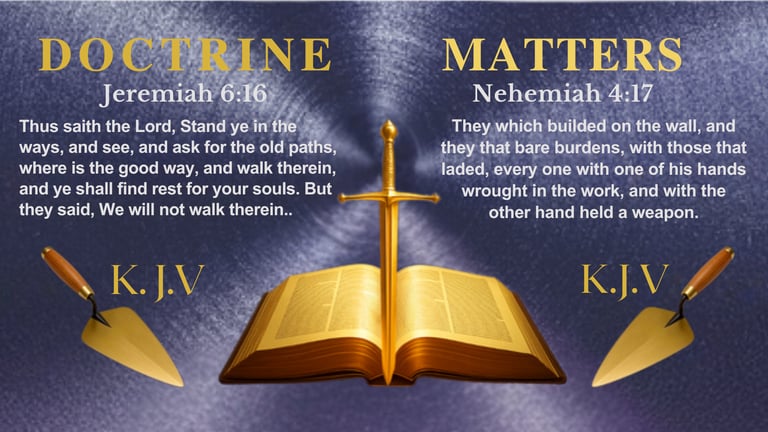
Doctrine Matters
Jeremiah 6:16
“Thus saith the LORD, Stand ye in the ways, and see, and ask for the old paths, where is the good way, and walk therein, and ye shall find rest for your souls. But they said, We will not walk therein.”
King James Version